Scam Prevention
Defense in depth to stop scam payments
Detect coercion in real time and prevent risky payments

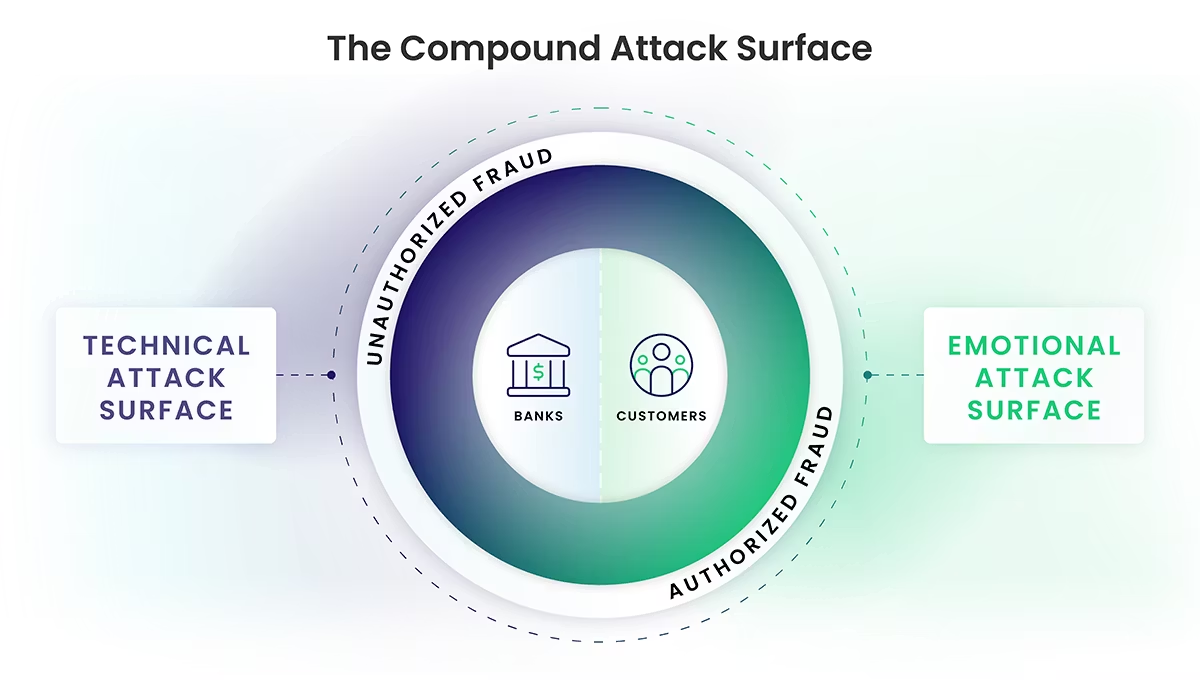
Scams have transformed the fraud landscape
Criminals have industrialized manipulation, using social engineering to push people into authorizing their own losses. The primary vulnerability is no longer the system, it’s the person using it.
The damage goes beyond losses for financial institutions. Every successful scam erodes customer confidence and trust in digital banking. Stolen funds also fuel organized crime, strengthening networks tied to exploitation and human trafficking.
Defense in depth to protect customers from scams
including Authorized Push Payment (APP) fraud
Outseer helps banks reduce scam losses for their customers and accelerates detection of mule networks, disrupting the illicit transactions that underpin scam operations.
Real-time behavioral biometrics and active call checks detect coercion or compromise during logins and payments. Consortium intelligence reveals emerging threat patterns across institutions. A unified risk engine fuses these signals to make precise, context-aware decisions.
Behind the scenes, mule account detection disrupts payout networks and cuts off stolen funds. Our FraudAction team shuts down scam sites and removes the online infrastructure used to deceive victims.
Behavioral Biometrics to Stop Authorized Push Payment Fraud
Detect authorized push-payment (APP) fraud by confirming the genuine user and device, then flagging abnormal behavior. Signs include delays, unusual timing, hesitation, repeated typing and deleting, and other irregular patterns. This is applied across:

Account management

Beneficiary management

Payments
Integrated risk signals for end-to-end scam defense
We help financial institutions protect customers across the scam lifecycle. Native risk signals feed one unified risk model to cut complexity and improve decision accuracy.

Protect every step of your customers' digital banking journey with a powerful, comprehensive fraud management platform that utilizes predictive AI and machine learning along with a powerful policy engine to help prevent fraud and ensure a more secure and streamlined digital banking journey.
Protect your customers, brand reputation, and bottom line with a rapid detection and takedown solution that detects and mitigates external threats including phishing attacks, scams, and trojans.
Tap into our knowledge base


Ready to get started?
Reduce fraud, prevent scams, and protect customers with industry-leading accuracy and minimal customer intervention.

Frequently asked questions about Scam Prevention
What is Authorized Push Payment (APP) fraud?
Authorized Push Payment (APP) fraud occurs when a customer is manipulated into authorizing a payment to a fraudster. Unlike unauthorized fraud, the payment is initiated by the genuine account holder, making APP fraud particularly difficult to detect using traditional authentication and transaction monitoring alone.
How is APP fraud different from unauthorized fraud?
Unauthorized fraud involves criminals accessing an account without the customer's permission. In APP fraud, customers authorize the payment themselves after being deceived through social engineering, impersonation, investment scams, romance scams, or other fraudulent tactics.
Why is APP fraud difficult to detect?
Every APP scam follows a different customer journey and creates different behavioral, transactional, and contextual signals. Because customers often use their own trusted devices and credentials, effective detection requires multiple risk signals rather than a single fraud indicator.
How can I assess my organization’s readiness to detect APP fraud?
Outseer's APP Scam Health Check helps organizations understand how effectively they detect and respond to Authorized Push Payment (APP) fraud. Delivered by Outseer's Fraud Advisory Services, the assessment identifies practical opportunities to optimize fraud strategies, policies, and platform configuration, providing actionable recommendations to strengthen APP fraud detection while improving customer protection and operational performance.
How does Outseer detect Authorized Push Payment fraud?
Outseer combines AI-driven risk scoring with behavioral intelligence, device, IP and location signals, consortium intelligence, and customer context to identify suspicious payment behavior in real time. This layered approach helps detect the diverse techniques used in APP fraud while reducing unnecessary customer friction.
What types of scams can Outseer help detect?
Outseer helps organizations identify a wide range of scam typologies, including impersonation, investment, romance, purchase, business email compromise, and AI-enabled scams. By analyzing behavioral, transactional, and contextual risk signals, Outseer adapts to evolving fraud tactics rather than relying on fixed scam definitions.
Can Outseer reduce customer friction while preventing scams?
Yes. Outseer evaluates multiple risk signals to distinguish genuine customer behavior from suspicious activity, helping organizations intervene only when additional verification or investigation is justified.
How does Outseer adapt to new scam techniques?
Fraudsters continually evolve their tactics. Outseer combines AI, configurable policies, behavioral intelligence, and global fraud insights to help organizations identify emerging scam patterns and respond quickly as fraud techniques change.